
What is CKP?
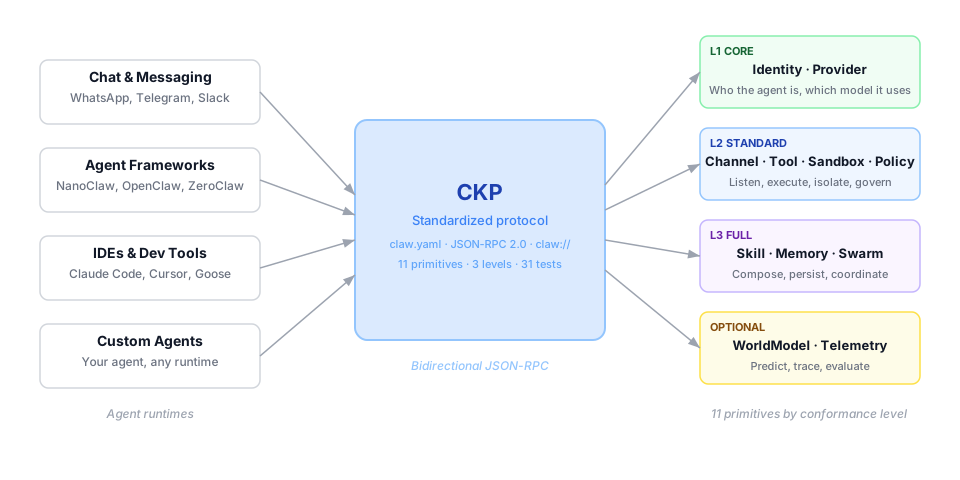
The Claw Kernel Protocol (CKP) is an open specification for describing, composing, and interoperating autonomous AI agents. It defines ten primitives that cover everything an agent needs: identity, inference providers, communication channels, tools, composed workflows, persistent memory, execution sandboxes, behavioral policies, multi-agent coordination, and observability.
Agents are described declaratively through a YAML manifest (claw.yaml). The protocol provides a formal ABNF grammar, a JSON-RPC 2.0 wire format, and a claw:// URI scheme for addressing agent components.
How CKP relates to MCP
Section titled “How CKP relates to MCP”CKP is complementary to MCP (Model Context Protocol), not a replacement for it.
MCP standardizes how LLM hosts discover and invoke tools, resources, and prompts from external servers. It solves the tool integration problem. CKP operates at a different layer: it standardizes how autonomous agents are assembled, secured, and orchestrated as first-class runtime entities.
In practice, any MCP server can be referenced as a CKP tool source. CKP’s Tool primitive is a strict superset of MCP’s tool definition, adding sandbox binding, policy binding, and lifecycle metadata on top of what MCP already provides.
CKP (Agent assembly, security, orchestration) | |-- extends --> |MCP (Tool/resource discovery) | |-- uses --> |JSON-RPC 2.0 | |-- over --> |stdio | HTTP/SSE | WebSocket | Message QueueThree conformance levels
Section titled “Three conformance levels”Not every agent needs every feature. CKP defines three conformance levels so implementations can range from minimal embedded binaries to enterprise swarm deployments:
| Level | Name | Required Primitives | Target Use Case |
|---|---|---|---|
| L1 | Core | Identity, Provider | Embedded devices, simple chatbots |
| L2 | Standard | + Channel, Tool, Sandbox, Policy | Personal assistants, team bots |
| L3 | Full | All 9 core primitives (Telemetry optional at all levels) | Enterprise swarms, multi-agent systems |
A valid L1 agent needs only an Identity and a Provider — it can run on a $10 board with a local Ollama instance. At L3, agents coordinate in multi-agent swarms with persistent memory, composed skills, and full policy enforcement.
The conformance harness ships with 31 test vectors (13 L1 + 10 L2 + 8 L3) so implementations can prove their level.
Learn more about each level in the Conformance Levels page.